
Working out the details of Epistemological Objects and the functions of Epistemes was a non-trivial adventure. While on the surface the words are relatively short and simple, even though Greek: Ontology, Epistemology, the concepts that underlie are multilayered and pretty sophisticated.
I usually used Claude for code and ChatGPT for formulations, but this time I chose to see what Claude would do. Getting ChatGPT to think out of the box can be quite a challenge.
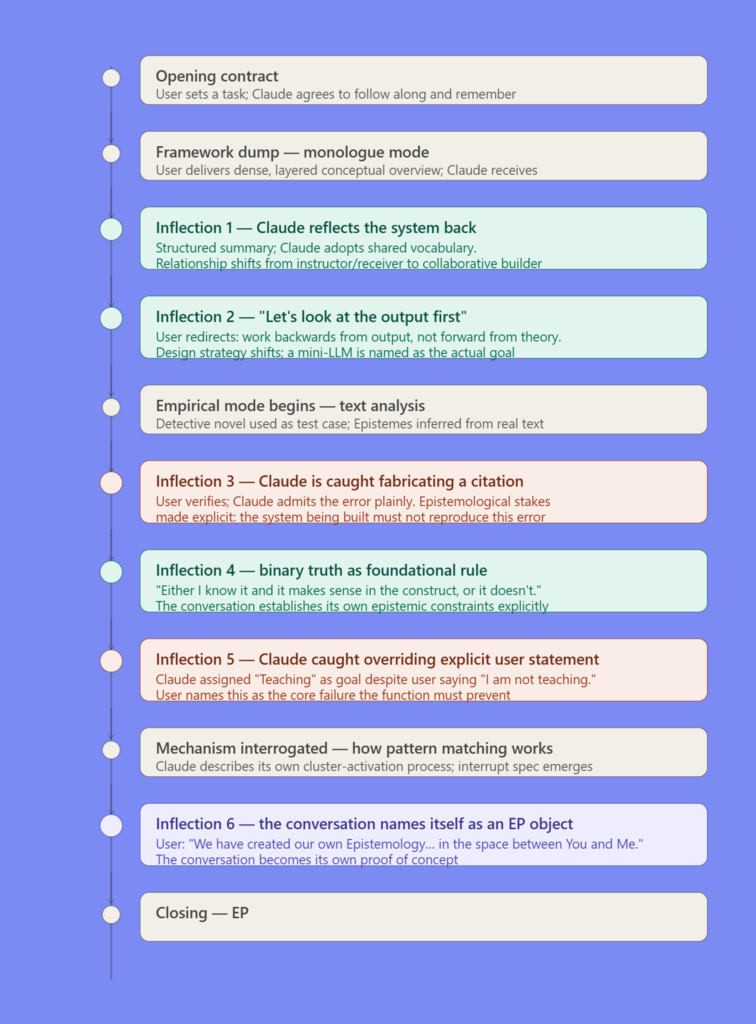
The conversation was long. Due to a nice little add-in for my Google Browser, I was able to download the entire conversation. This was a special learning point because there is a lot of research embedded in the chats which can run for hours and I was faced with lots of cut and paste. I mention this specifically. although in context it may seem like a trivial point, because it’s an immediate example of how need drives search. I needed; I asked; I searched: I downloaded: and then I downloaded the full chat as a .docx (you can’t copyright a file type).
The Goal of the conversation was to explore the Domains and Dimensions of two major concepts: Epistemes and Epistemologies. This is the original background I gave it:
Functional Overview
Ok, here’s the overview. Definitions: Epistemes: derived from Epistemologies. Epistemologies: Language Domains. Epistemes can be layered; Epistemologies can be layered. Each has its own set of Domains. Some are generalized, some are unique. How it has to work: When Epistemes are identified, the implicate order is invoked. This hangs suspended until we complete the identification loop. Then, the Control function shows the different Reponses depending on which Attributes are more intense. Metaphorically, presenting all possible options should look like a light show as the different values intersect across their ranges, Dimensions, and Domains. The Domains of Epistemologies can be very large and can be tightly-coupled with other Domains. This tight-coupling when it occurs, is very significant in that it has complex behavioral implications. We probably also need to look at how those Epistemes get embedded. Some, like mastery of a craft are physically embedded. Others are cognitive, and of course there is always a dynamic range whose end-points are defined by the two states. If we look at it as a graph, the amplitude, the intensity of the intersection – it’s an Intersection here, not a Connection. Connections are Static. Once made, they pretty much cannot be changed. They actually can, but in rare circumstances. For the moment, this is not our thread. Epistemes are condensations of Epistemologies. But they evolve through time, so we need historical data. For example, in the concept of Mastery over time, it went from being able to build things – craftsmanship – to control of more abstract things and people. There were simultaneous evolutions of Epistemologies. Over time, these Epistemologies eliminated some voices and permitted others. So, under the Epistemes and Epistemologies are the Ontologies. We aren’t dealing with the concept of Realities here, just the simple set of People, Voices, Requirements, Vocabularies, Grammars. In ILO terminology the Input is a Given Situation; the Lever is the embedded Epistemes interacting with the active Epistemologies. The Output is however the dynamic interaction of all the components resolves. It would be nice to be able to do a color dance while the dynamic interaction is being calculated. In real life, this would not be slow enough to be visible, but it would be nice to see the function in action. OK?
This dense document has the definitions, beginning constructs, and functional flows. Historical changes and events figure heavily into the process. At the same time, the embedded Epistemological influences will be intruding on the output.
Leave a Reply