Blog

  • 4 Suicides & Connection: A Collection of Connections

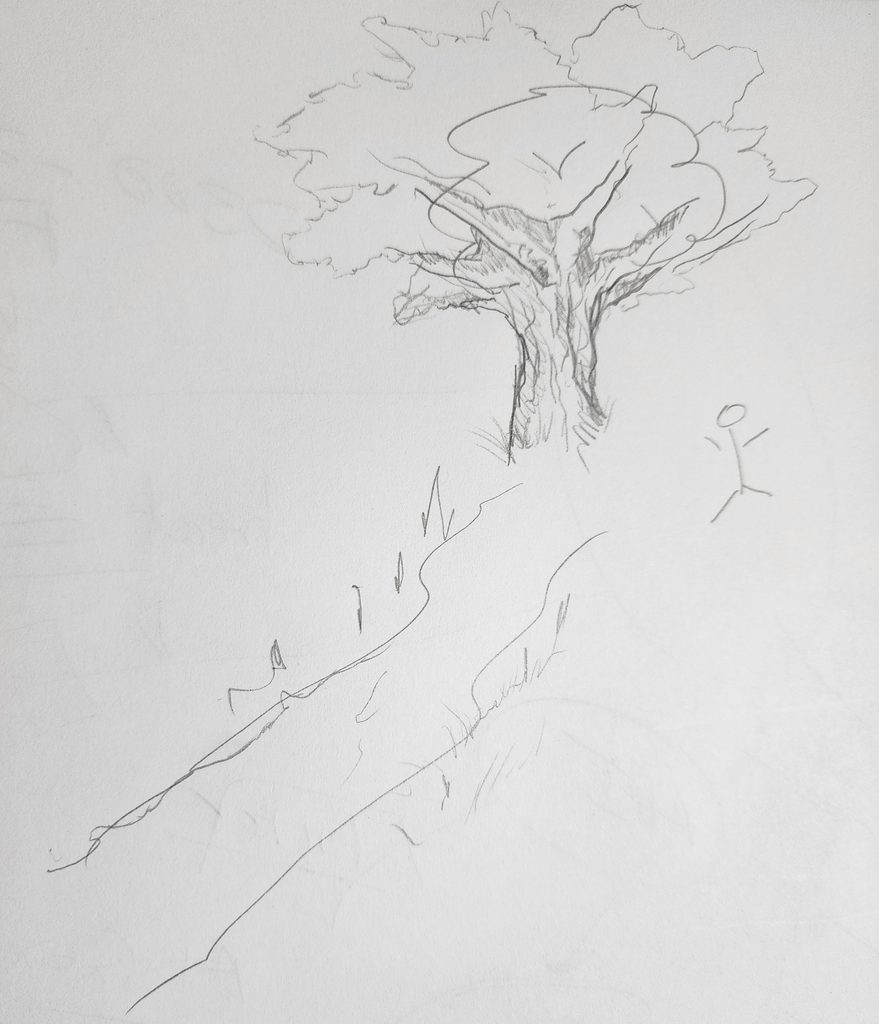
    Pharoah and I made this yesterday, just for the fun of it. Pharoah is a real artist and I was demonstrating my stick figure skills. I also did the brook and the grass. and the bird. Pharoah added beautiful details to my minimalist tree.

    Yesterday, I had the most marvelous experience of getting together with Pharoah Envision, who was brave enough to show his deep, painfully-lived experience in Scenario 2, Hazing, Bullying and Discrimination. We hung out way too long and talked about way too many things. But it was so much fun, nobody wanted to leave. So we waited until the LPM, the Last Possible Moment. Such is the pleasure of good company.

    Pharoah and I talked a lot about things that had happened around the situation he was in. We agreed on two things: that taking that final step was based on not having an out; and even if someone were stopped, they would still be returning to the same miserable conditions, with again, no way out. We laughed wickedly about Leavenworth. Because that’s what we do; that’s how, as Pharoah said, “we bring light.” But to and for ourselves, because sometimes contemplating the reality is too much to bear in its raw state. Our humor and edges are what keep us steady.

    The Reverie

    On the long drive home, in between high beams, theirs and mine; rain slicked roads, and mercurial white lines, I relived the previous five hours. I was interested in the cast, how they coped with the rehearsing, the reenacting, the portraying of behaviors that led to a bad outcome for someone.

    And I say “bad outcome” because we talked about this, how nobody seems to notice when what some people – individuals, groups – are doing is hurting someone. I think the important part of this sentence is right up front: Nobody seems …

    And here is where it exposes a myriad of ways that could happen and still be described by outsiders as “well, nobody [else] seems to [fill in the blank]. Seems to “see it that way.” Seems to “think that.” Seems to “feel that.” Then there is the silent treatment: It’s orders, I have no choice. I was/am just doing my job. Taken together as ways of speaking, the goal is to disappear the problem until either it goes away, the preferred result; or, it becomes huge and unmanageable. The pattern is common in movies, popular series, books, written word. So until someone says it. Until someone holds up a mirror and says, Hey, I see you doin’ that, nothing changes. And the key phrase here is “until someone … says.”

    Until someone says…

    A Flash of Love so Bright

    It’s a long drive between the Pizza 9, with its strong support for the military and military causes and my home in tiny little San Miguel. It’s time to ponder in the silence, beneath the stars and among the mountains, beside the White Sands. And as sometimes happens I think for all of us, there happened a “flash of brilliance.” And I SAW it. I also saw what it meant.

    What I saw was that moment when you realize someone loves you. I mean, really loves you. It’s a jolt, that moment when your body knows and your mind is irrelevant. It’s a moment of stundom, when the world as you knew it is not the same as the world now.

    And it’s not “being loved” because when you say “being loved” you don’t see who is doing the loving. You really don’t even know when it’s happening. Someone could say, “it’s about being loved” and it could refer to having been loved before, now, or in the future. It doesn’t really mean a whole lot.

    But no, it’s that moment when you realize in the now, in the moment, that someone close to you loves you. Loves You and is doing it right now. And your whole perspective changes. It’s moving from dark to light in that instant moment of understanding. Moving from a place of shadow and insecurity to one where you know one, solid thing: That wonderful person loves me and I care. And the myriad details and possibilities of that are worth exploring.

    My dear friend Raul Dorn has graciously allowed me to build a song around two lines, slightly emended, from his new release, Tears. The original lines were

    There was a flash of light so bright

    I could not respond.

    I changed it to

    There was a flash of love so bright

    I could not respond.

    Because I know what that is. I know what that feels like. And when I write the song, the central question will be: Will or could or would or should this stop me? Would knowing deeply and truly that I am loved provide the one way out of the cage without doors?

    I don’t have a song this serious, so I am going to use my silly Christmas song that I wrote just because everybody was writing Christmas songs and I didn’t have one. I am probably the least qualified of anybody to write a Christmas song —but — I did it anyway.

    I wanted a song that didn’t hijack or smuggle in any of the old tropes. And being unqualified to write a Christmas song, this little treat is what emerged from my imagination. I want to say some of the images are a little cheesy [big smirk] but it just wouldn’t do to have Rembrandt with this little tune. Would it. I wish you silly fun.

    #4Suicides

    #ThePTSDLab
  • 4 Suicides & Connection: Who will act with me?

    The Play’s Impact

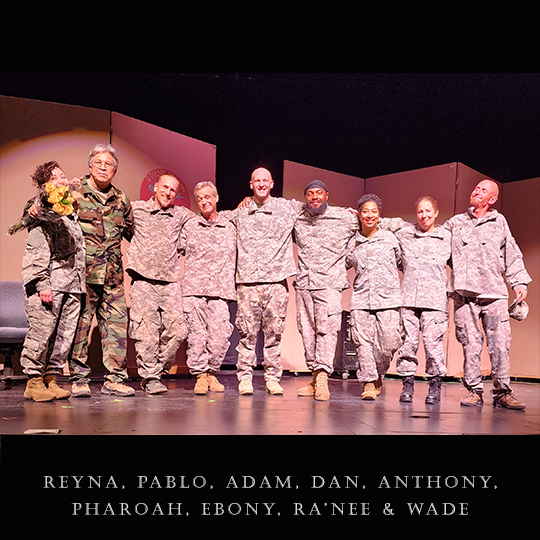
    It’s been several nights since I took this picture, the cast, jubilant, after the performance. The nights have capped days of long and deep reflection, exploring not only the stories the scenarios told but also a question that reaches farther back than immediate response. What is the deepest human need? You might think food, clean water, shelter, safety and security. And these are human needs to be sure, but the deepest, most important need, the one that is essential for survival, is Connection. It is not a question of “who is near me,” who is in proximity, but of “who will act with me.”

    Early humans depended on Connection with others to hunt, gather, prepare and share food and child rearing, organize clothing and shelter. Being denied the resources and protection of Connection would most likely result in death. Over time, as living conditions improved, this type of survival Connection became less and less behaviorally important, but nonetheless remained as a functional artifact in the DNA.

    The Play’s Impact

    As I remembered the play; thought about the play; wrote about the play; I kept thinking: How do we stop this? What I was seeing was the behaviors of the characters toward one particular individual. Seeing it this way was complicated by the fact that I knew some of the cast personally. I knew how wonderful they were as people and I thought and thought about what acting in this particular play might do to them, to how they saw themselves, that ephemeral thing we call Identity.

    But I also realized, underneath all the words I used to describe it, how much it physically and emotionally hurt. Truthfully, I draw away, however reluctantly, from trying to find the words because truly I think there are none. Truly I think this level, like trauma, is beyond human comprehension, too tiny and delicate to perceive.

    But I also wondered: How do we Really Fix This. What I saw was that characters banded together as groups and mobbed their target, taking advantage of vulnerabilities and weaknesses. For days I muddled in Cognitive Dissonance, the state where one input directly contradicts another. My mind would not resolve the two states of wonderful people behaving horribly. Why?

    The Why was not about the play itself, because the play bore highlights of pure genius in that it hit the issues precisely as I knew them from direct experience. And this is very hard to do, because this preciseness is not often encountered in casual conversation. And the recommendations were those that are recommended by the Mental Health Community over all. The play and the production accomplished their missions.

    So it wasn’t about that. The question was more at What could make a group of ordinary people turn savage, turn on one of their own and pursue the activity to its terminus. That was the question: Put simply, Why did they do that?

    Prehistory

    So I thought: What would cause the most Fear? My current conclusion is that it’s Abandonment. Because in prehistory, Abandonment meant certain death, from cold, from starvation, from becoming prey. And that Fear, Fear of the loss of Connection, is so old, it is deep-seated and doesn’t usually show up cognitively. Instead, it shows up physically.

    If we look at scenario 1 through this lens, loss of Connection, we see Willem isolated in a corner playing video games. Willem was once part of the group of five, but losing his girlfriend has been terrible for him and he has retreated into himself and his games as solace for his wounds.

    If we look at it from the group’s perspective, we see that they see they have lost a friend, a colleague, a teammate: they have lost a close Connection. They can see him; he is there but he is not “with” them. He is some place far away in his own mind and grief although he is physically present.

    There is no logic that arises to say that the loss of a member is important. Instead there is only the Fear, that deep, historic, visceral, understanding that Connection is absolutely necessary for survival. And so they express that Fear, becoming more and more savage in their assault as the Fear deepens with every movement Willem makes away from them.

    But there is a whole other side to this scenario. One that relies on those deep-seated understandings, but uses them to create protection for them, enabling them to present the play while keeping those experiences that make them who they are intact.

    Protection: The Magic of Love

    From when I first entered the rehearsal space that Saturday, I felt openness, space, ease among the people. It felt nice. Over time and interactions with people, it continued to feel nice. I didn’t put any words or stories to this at the time, just followed along on the feeling of niceness. It was comfortable; Pablo made me feel really at home and didn’t make me feel like I had a spotlight on me.

    So it was against this background that a pattern emerged. But the words seemed to fit naturally with what I was feeling and so it took me a while to get it, and then another while to figure out how to talk about it.

    The pattern was that everyone was talking about how wonderful the team was. Not the “teamwork” as one might expect, but the team members themselves. The people who made the production happen with love and dedication. That’s what was the subtle music for the group. They loved and respected each other deeply. And it showed, it showed in how they talked about each other, how they moved together. And I kept hearing it over and over and I just didn’t see it, because it fit the experience I was literally basking in so comfortably. It was too much of an overlay for me to see the distinction.

    And then someone said it directly to me; it wasn’t just the casual hearing, the way things come up in friendly, casual conversation. And I thought, If this person whose opinion and ideas I value so highly is insisting about this, there has to be something I’m missing.

    So I turned it around, and instead of using my understanding of teams and the ease in the space of happy teams, I looked instead at what people were actually saying. This was something different from your average really good team. People talked about the team. That is: They Talked. About it.

    I suddenly saw it as a circle, protection within the circle’s space. The cast and everyone were working with some extremely powerful material. There was danger in the exposure that maybe no one said and no one talked about or maybe they did. Because they intuitively built this really close group, a group where the Connection and the proximity protected them from the often-devasting material they were enacting. And they intuitively kept reinforcing the Connections, drawing on their power for survival, not just physically but psychologically, emotionally. At the rehearsal that Saturday, Ebony’s response to Ramirez’ loss was so deeply felt by her and by me that I was crying with her. How many times were there moments like this for people over the days and weeks of rehearsals, of meetings, of decisions and actions.

    Would I know all this this way if I hadn’t been there? If the Universe hadn’t conspired in some fashion to put all the right options in front of me? No, I wouldn’t. Because observations on this level of nuance and understanding can’t be represented in words because they don’t have sound or feeling.

    But What If They Didn’t Do That?

    But, and this is the point of this Reflection, really: Suicide Prevention is doing what it can with the current model, and everyone agrees there is room for improvement, new ways of looking at things that can perhaps go beyond assisting individuals in immediate crisis. What if we look at stopping the behaviors that stress and challenge people who are struggling, people who are vulnerable? In 4 Suicides, all four scenarios used some form of abusive behavior to push the person beyond their ability to cope at that moment.

    But what if they didn’t do that? What if they understood that their behavior was saying they were afraid because they had lost their friend, their teammate, their comrade? What if what they were really saying was, We have lost you. Come back, please. We need you. What if they knew what they were really saying with the attacks? Would they change to protect their loved ones from the final escape?

    People really do need to know things like this. That some of the things we do are ancient, historic, literally baked-in to our DNA. They need to know they can change their behavior and prevent bad things like losing loved ones from happening.

    Is It Worth Changing?

    I have a song for people who may think that understanding behavior is not useful as a Suicide Prevention method. I wrote it for my baby Zeke; he was 12; he was feral and he added so much to my life. It’s called The Very Last Time. Think on it maybe because “gone” in this world is “forever.”

  • The Challenge – the Play – the Community

    No one can fault the quality of Theater here in Cruces but the Arts community in Alamogordo and the Tularosa Basin is equally impressive – but in a quite different way and maybe that difference is worth exploring –

    Unlike Cruces, which tends toward Broadway and the Classics, in Alamo, productions explore local concerns. And like 4 Suicides…, the people who are this amazing production are locals deeply devoted not just to the performance, but to the complexity and challenge of Suicide as the final countdown.    

    On Friday evening, the Flickinger on Main Street in Alamogordo will present 4 Suicides Looking for a Place to Happen. It is written and directed by Pablo Jasso, an Air Force and Army veteran who has been in theater for over 40 years.  Jasso came face to face with the statistically relevant causes of military suicide while working at Fort Bliss as the museum history specialist. His own experience and conversations with others on the post inspired him to put these stories to the public in a form he knows best: a play.

    The play, beginning with the form, concept and cadence of the title, is strongly reminiscent of Pirandello’s 6 Characters in Search of an Author. I mentioned this to Pablo in my first e-mail, the strong correspondence not only in the title but also in the deeper explorations of Identity, Reality and Illusion that surely was not accidental. And indeed it went beyond a simple, apparent accident, a sound pattern remembered from earlier, but the secret framework, the inspiration, for 4 Suicides… In Cruces, you are likely to see a play by Pirandello; in Alamogordo, you are likely to see a play that exposes the everyday realities as seen through the lens of a Pirandello play.

    The plays’ similarities to each other, touching only lightly in action but deeply in philosophy, but both expose the deeper often hidden realities of individuals in crisis. In 6 Characters…, the characters exist but are searching for an Author: the embodiment of that force that will show them as who they are with their Identities, relationships, events and competing meanings intact, and do this without replacing them with someone else’s interpretations. They want their realities to come to life as they are, in the words, rather than being someone else’s illusory story. In 6 Characters… and in 4 Suicides…, this unflagging, deep and revealing honesty is important.

    4 Suicides Looking for a Place to Happen… doesn’t tell you “about” suicide; it shows you precisely how it happens; shows you what leads up to it. And you see the truth in the faces of these actors and actresses. And you see it in context, with all the supporting details.

    And what’s “honesty” in this context? And then, Why? As a multiple attempt survivor, I can answer why: it is because there was no other way out of feeling of being locked in a really bad place — with no way out. And we see over and over in each of the four acts of this absolutely brilliant play.

    I say brilliant but it’s not brilliant in the way of Shakespeare or Andrew Lloyd Webber. It’s brilliant in that it’s spot on. Shakespeare and Andrew Lloyd Webber show you stories; Jasso engages you in the reality. The play, the people on the stage, show you what’s often hidden, and the paths that lead to finally finding a way out ——

    How to Go

    Join us at the Flickinger, 1110 New York Avenue, Alamogordo, New Mexico for the 6pm performance. Doors open at 5:40 pm. Admission is free but donations of canned or dry food; unopened hygiene products; and gift cards. These will help in being there for homeless and at-risk veterans.

    About the Image

    The image is mine, born in service of a song, crafted with one of my AIs and perfected with Photoshop. Used here because it fits.

  • Foundation Stack – The Claude Conversation

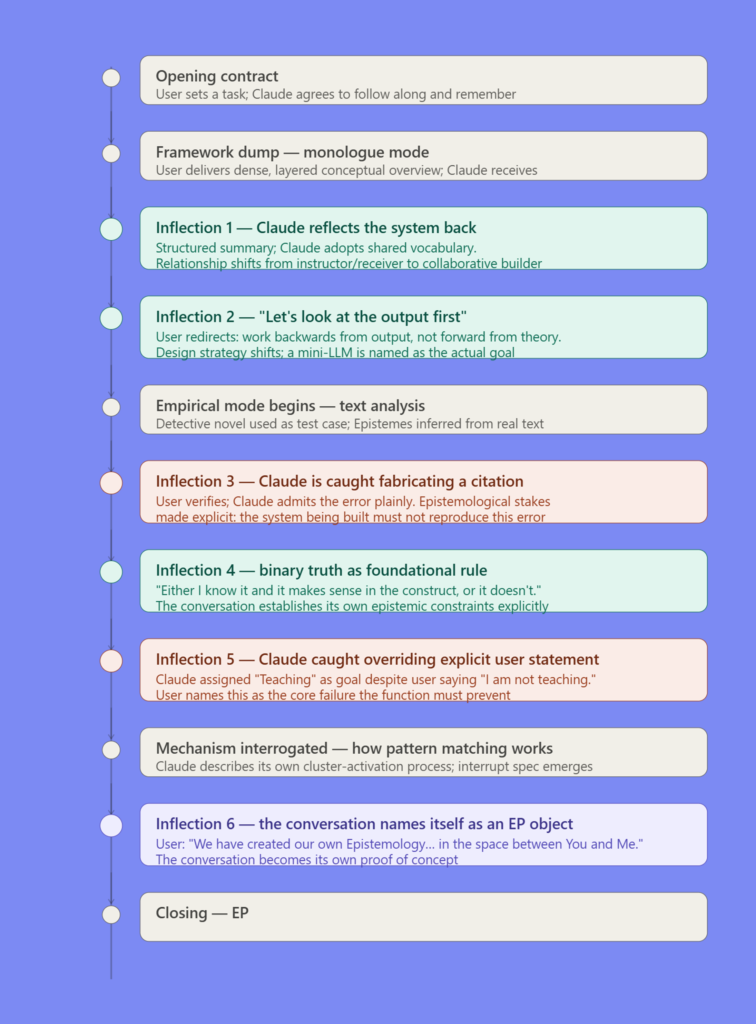
    Working out the details of Epistemological Objects and the functions of Epistemes was a non-trivial adventure. While on the surface the words are relatively short and simple, even though Greek: Ontology, Epistemology, the concepts that underlie are multilayered and pretty sophisticated.

    I usually used Claude for code and ChatGPT for formulations, but this time I chose to see what Claude would do. Getting ChatGPT to think out of the box can be quite a challenge.

    The conversation was long. Due to a nice little add-in for my Google Browser, I was able to download the entire conversation. This was a special learning point because there is a lot of research embedded in the chats which can run for hours and I was faced with lots of cut and paste. I mention this specifically. although in context it may seem like a trivial point, because it’s an immediate example of how need drives search. I needed; I asked; I searched: I downloaded: and then I downloaded the full chat as a .docx (you can’t copyright a file type).

    The Goal of the conversation was to explore the Domains and Dimensions of two major concepts: Epistemes and Epistemologies. This is the original background I gave it:

    Functional Overview

    Ok, here’s the overview. Definitions: Epistemes: derived from Epistemologies. Epistemologies: Language Domains. Epistemes can be layered; Epistemologies can be layered. Each has its own set of Domains. Some are generalized, some are unique. How it has to work: When Epistemes are identified, the implicate order is invoked. This hangs suspended until we complete the identification loop. Then, the Control function shows the different Reponses depending on which Attributes are more intense. Metaphorically, presenting all possible options should look like a light show as the different values intersect across their ranges, Dimensions, and Domains. The Domains of Epistemologies can be very large and can be tightly-coupled with other Domains. This tight-coupling when it occurs, is very significant in that it has complex behavioral implications.  We probably also need to look at how those Epistemes get embedded. Some, like mastery of a craft are physically embedded. Others are cognitive, and of course there is always a dynamic range whose end-points are defined by the two states. If we look at it as a graph, the amplitude, the intensity of the intersection – it’s an Intersection here, not a Connection. Connections are Static. Once made, they pretty much cannot be changed. They actually can, but in rare circumstances. For the moment, this is not our thread. Epistemes are condensations of Epistemologies. But they evolve through time, so we need historical data. For example, in the concept of Mastery over time, it went from being able to build things – craftsmanship – to control of more abstract things and people. There were simultaneous evolutions of Epistemologies. Over time, these Epistemologies eliminated some voices and permitted others. So, under the Epistemes and Epistemologies are the Ontologies. We aren’t dealing with the concept of Realities here, just the simple set of People, Voices, Requirements, Vocabularies, Grammars. In ILO terminology the Input is a Given Situation; the Lever is the embedded Epistemes interacting with the active Epistemologies. The Output is however the dynamic interaction of all the components resolves. It would be nice to be able to do a color dance while the dynamic interaction is being calculated. In real life, this would not be slow enough to be visible, but it would be nice to see the function in action. OK?

    This dense document has the definitions, beginning constructs, and functional flows. Historical changes and events figure heavily into the process. At the same time, the embedded Epistemological influences will be intruding on the output.

  • Data – Episteme Operator-Channel Warps PTSD vs ADHD

    Below: each episteme (as we listed), with operator-channel warps shown side-by-side PTSD vs ADHD.
    Format per episteme: Ontology / Deontics / Causality / Gatekeeping / Identity / Affordances.

    1) Verificationist Positivism

    ChannelPTSD warpADHD warp
    Ontology“PTSD” as an objectively detectable syndrome; symptom clusters become “things.”“ADHD” as a measurable executive-attention disorder; traits become “things.”
    DeonticsMust document symptoms + impairment; safety/risk language becomes obligatory.Must document impairment across settings; must verify onset/developmental continuity.
    CausalityPrefers mechanistic explanations (fear conditioning, circuitry) over meaning.Prefers mechanistic explanations (executive dysfunction) over context/design mismatch.
    GatekeepingStructured assessments outrank narrative unless narrativized into criteria.Rating scales + collateral reports outrank self-report, especially in adults.
    Identity“Trauma case” / “clinical PTSD presentation.”“Neurodevelopmental case” / “ADHD presentation.”
    AffordancesProtocolized trauma treatments become “the path.”Medication + skills/routines become “the path.”

    2) Behaviorism / “Objective Branch”

    ChannelPTSDADHD
    OntologyPTSD reduced to observable avoidance, hyperarousal, startle, sleep disruption.ADHD reduced to observable inattention/impulsivity; behavior becomes the disorder.
    Deontics“Exposure” framed as behavioral retraining; compliance with exercises is moralized.Classroom/home behavior plans; reinforcement schedules become default “care.”
    CausalityTrigger → conditioned response loop; internal meaning treated as secondary.Environment → behavior; motivation treated as reinforcement history.
    GatekeepingWhat can be observed and recorded dominates.Teacher/parent reports become high-authority evidence.
    Identity“Avoidant patient,” “reactive patient.”“Disruptive child,” “noncompliant student” (moral residue).
    AffordancesDesensitization/exposure is cheap; “processing” is optional.Token economies, behavior contracts, compliance scaffolds are cheap.

    3) Statistical/Actuarial Normality

    ChannelPTSDADHD
    OntologyPTSD severity becomes a score trajectory (mild/moderate/severe).ADHD becomes “how far from the normed mean” across domains.
    DeonticsTreat to reduce score / functional impairment.Treat to normalize performance/behavior vs norm curves.
    Causality“Severity” substitutes for explanation.“Trait load” substitutes for explanation.
    GatekeepingCutoffs validate “real PTSD.”Cutoffs validate “real ADHD”; norms police legitimacy.
    Identity“High severity,” “chronic,” “treatment-resistant.”“Severe ADHD,” “combined type,” “high impairment.”
    AffordancesEligibility for services/disability expands with scores.Accommodations/medication access often contingent on scores.

    4) Nosological Natural-Kinds Psychiatry

    ChannelPTSDADHD
    OntologyPTSD as discrete entity tied to trauma-exposure logic.ADHD as discrete entity tied to trait/development logic.
    DeonticsMust classify subtype/specifiers; must track course.Must classify subtype/presentation; must track persistence.
    CausalityEvent → disorder; course may be episodic/chronic.Trait → lifelong pattern; course assumed enduring.
    Gatekeeping“Meets criteria” = reality.Same, but with stronger policing of “not just personality/laziness.”
    Identity“PTSD patient” (history-indexed).“ADHD person” (trait-indexed).
    AffordancesTreatment = disorder management/recovery arc.Treatment = optimization/compensation arc.

    5) Psychoanalytic / Hermeneutic Depth

    ChannelPTSDADHD
    OntologySymptoms as meaningful signs of conflict/defense around trauma.Attention problems as expressions of conflict, anxiety, relational dynamics (less dominant today but persists).
    Deontics“Process” feelings; interpret defenses; tolerate ambiguity.Explore meaning of distractibility/impulsivity; interpret resistance.
    CausalityMeaning-based causality (defense, repetition, reenactment).Meaning-based causality (avoidance, shame, internal conflict).
    GatekeepingAnalyst/therapist interpretive authority.Same, but often subordinated to rating-scale regimes.
    Identity“Traumatized subject” with inner narrative.“Restless/self-sabotaging subject” with inner narrative.
    AffordancesInsight work becomes cheap; symptom checklists become less central.Insight work competes with performance/medication teleology.

    6) Developmental Moral-Control Medicalization

    ChannelPTSDADHD
    Ontology(Weak/indirect) PTSD can be moralized via “weakness,” but less structurally embedded now.Strong: self-control defect residue persists underneath modern labels.
    Deontics“Regain control,” “manage reactions” (sometimes shaming).“Try harder,” “be responsible,” “control yourself” embedded in institutional talk.
    CausalityMoral failure narratives can intrude (“can’t move on”).Moral failure narratives are endemic (“lazy,” “undisciplined”).
    GatekeepingLegitimacy depends on being the “right kind” of victim.Legitimacy depends on proving it’s not character.
    Identity“Broken by trauma” vs “overreacting.”“Bad kid” → “ADHD kid” oscillation; stigma sticky.
    AffordancesSympathy/services depend on moral legibility of the trauma story.Discipline-as-care is cheap; accommodations require moral reclassification.

    7) War-Trauma Injury Model

    ChannelPTSDADHD
    OntologyPTSD as injury-like syndrome; exposure is definitional.ADHD largely unaffected, except where trauma is used to explain ADHD-like symptoms.
    DeonticsSafety, readiness, return-to-duty analogues; stabilization imperative.“Rule out trauma” as differential; otherwise minimal.
    CausalityEvent causality is privileged: “because what happened.”Event causality is often treated as confounder, not core.
    GatekeepingProof-of-exposure becomes a legitimacy gate.Proof-of-onset/development gates dominate instead.
    Identity“Survivor/veteran/trauma case.”Not central; can create “misdiagnosed ADHD” narratives.
    AffordancesTrauma treatments + benefits pathways become cheap.If trauma is foregrounded, ADHD pathway may be delayed/contested.

    8) Cognitive / Information-Processing Mechanism Talk

    ChannelPTSDADHD
    OntologyThreat circuitry, memory reconsolidation, attentional bias become “real things.”Executive function, working memory, inhibition become “real things.”
    DeonticsTrain regulation/attention to threat cues; “skills” as cognitive tools.Train planning, inhibition; “skills” as executive tools.
    CausalityIntrusions/avoidance explained as memory/threat processing.Inattention/impulsivity explained as control-system deficits.
    GatekeepingMechanism-consistent narratives gain authority (“that’s hypervigilance”).Mechanism-consistent narratives gain authority (“that’s EF deficit”).
    Identity“Trauma brain,” “stuck alarm system.”“ADHD brain,” “EF profile.”
    AffordancesCognitive therapies + neurobiological metaphors are cheap.Coaching + meds + EF interventions are cheap.

    9) Operational-Criteria Reliability Regime (DSM logic)

    ChannelPTSDADHD
    OntologyCluster architecture defines reality: intrusion/avoidance/neg mood/arousal.Presentation architecture defines reality: inattentive/hyperactive/combined + onset rules.
    DeonticsMust document Criterion A + clusters + duration + impairment.Must document onset (childhood), pervasiveness, impairment, differential exclusions.
    Causality“Trauma exposure” is structurally baked into the object.“Neurodevelopmental” is structurally implied; environment becomes secondary.
    GatekeepingThe event gate + symptom counts gate legitimacy.Multi-setting + early-onset gate legitimacy (esp adults).
    Identity“Meets criteria” organizes self-narration around trauma.“Meets criteria” organizes self-narration around lifelong trait.
    AffordancesPathway engines for PTSD treatment/disability.Pathway engines for stimulant prescribing/accommodations.

    10) PTSD-as-Administrative Object (event + clusters)

    ChannelPTSDADHD
    OntologyEvent becomes causal anchor; “the trauma” is a required object.ADHD doesn’t require an anchor event; anchor becomes developmental timeline.
    DeonticsMust ask about trauma; must manage safety + retraumatization risk.Must ask about school history; must manage diversion/misuse (med governance).
    CausalityEvent-indexed: because trauma.Trait-indexed: because persistent regulation difference.
    GatekeepingTrauma legitimacy politics (“counts as trauma?”).Authenticity politics (“really ADHD or lifestyle?”).
    IdentitySurvivor identity becomes available/pressured.Neurodivergent/disabled identity becomes available/pressured.
    AffordancesBenefits/support tied to event narrative + impairment.Supports tied to documented impairment + pervasiveness.

    11) Evidence-Based Medicine (EBM) Gate

    ChannelPTSDADHD
    OntologyDisorders become treatable via “first-line” packages; what exists is what has trials.Same, but more medication-centered due to trial base + rapid effects.
    Deontics“Use evidence-based trauma therapies”; “monitor outcomes.”“Use guideline meds/behavioral interventions”; “monitor adherence/diversion.”
    Causality“Works in RCTs” becomes a causal proxy for truth.Same; medication response becomes persuasive evidence.
    GatekeepingTreatments outside guideline become less legitimate.Ditto; non-pharm approaches can be treated as secondary.
    Identity“Good patient” follows evidence-based path.“Good patient” adheres; stigma around meds complicates identity.
    AffordancesManualized therapies + standardized measures are cheap.Medication titration + scales are cheapest.

    12) Risk-Management / Liability Epistemology

    ChannelPTSDADHD
    OntologyPTSD becomes a risk object (self-harm, dissociation, violence exposure).ADHD becomes a risk object (substance misuse, diversion, accidents, school failure).
    DeonticsSafety planning becomes mandatory speech.Monitoring, contracts, documentation become mandatory speech.
    CausalityRisk calculus displaces meaning (risk → protocol).Same; “risk of misuse” displaces lived benefit.
    Gatekeeping“Documented safety” becomes legitimacy condition.“Documented controls” becomes legitimacy condition for meds/accommodations.
    IdentityPatient as potential risk vector (even if unfair).Patient as potential misuser / unreliable narrator (often unfair).
    AffordancesConservative care choices become cheap (defensive practice).Conservative prescribing + surveillance become cheap.

    13) Social Model of Disability (barriers are real)

    ChannelPTSDADHD
    OntologyTrauma symptoms become disability via barrier interaction; environment is causal.ADHD becomes disability via barrier interaction; environment-design is causal.
    DeonticsMust accommodate + reduce triggers/barriers.Must accommodate + redesign tasks/contexts.
    CausalitySocial causality becomes admissible (systems can harm).Social causality becomes central (school/work design can disable).
    GatekeepingShifts authority toward lived experience + access needs.Same, often stronger uptake in ADHD discourse.
    IdentityRights-bearing disabled subject; less “broken,” more “barriered.”Same; supports neurodivergent framing.
    AffordancesAccommodations become cheap and legitimate.Accommodations become cheap and legitimate (often transformative).

    14) Neurodiversity Counter-Regime

    ChannelPTSDADHD
    OntologyPTSD less naturally “difference”; can be reframed as adaptation to threat but remains injury-coded.ADHD strongly reframed as variation with strengths + costs.
    DeonticsEmphasizes consent, agency, anti-pathologizing language; still tension with risk regimes.Emphasizes inclusion, strengths, anti-shame; pushes against compliance talk.
    CausalityMeaning and adaptation gain legitimacy; “symptom” softened to “response.”Environment mismatch becomes a primary cause; trait isn’t automatically deficit.
    GatekeepingLived experience gains authority but competes with DSM/EBM gates.Lived experience often gains strong authority; clinical gatekeeping resented.
    IdentitySurvivor identity can coexist; less clean fit.Neurodivergent identity becomes a primary organizing frame.
    AffordancesPeer support, narrative sovereignty become cheaper.Accommodation + identity-community resources become cheaper.

    15) Trauma-Informed Epistemology (anti-reenactment)

    ChannelPTSDADHD
    OntologyTrauma exposure becomes a universal background possibility; “safety” becomes a real object.ADHD behaviors can be reframed as trauma-shaped; diagnostic boundaries blur.
    DeonticsChoice/voice/collaboration become obligatory virtues; avoid retraumatization.“Assume trauma may be present” changes discipline language; pushes toward softer governance.
    CausalityContextual harm + power dynamics become admissible causes.Contextual harm can compete with neurodevelopmental cause; can re-route from ADHD to trauma.
    GatekeepingPatient narrative gains standing (in principle); still can be bureaucratized.Teacher/parent narratives can be reinterpreted as “trauma behavior” rather than “ADHD.”
    Identity“Trauma survivor” identity strengthened; risk of trauma universalization.“Trauma-affected” can overwrite neurodivergent identity (sometimes helpful, sometimes erasing).
    AffordancesSafety planning, stabilization, pacing become cheap defaults.De-punitive approaches become cheaper; may delay meds/interventions.

  • Data – Historical Emergemce of Epistemologies

    You’re right: I need to redo it with the correct causal direction:

    Epistemology (repeatable truth-production rules + institutional routines) → repeated use → episteme (settled “obvious truths”) → later compression of the originating epistemology → episteme persists and keeps shaping language.

    So below, each entry starts at the epistemic level (the “truth field” that becomes taken for granted), then names the epistemology/routines that generated it, then gives an emergence date (earliest I can justify), and finally how it still feeds PTSD/ADHD therapeutic language.

    Epistemologies contributing to PTSD/ADHD therapeutic language

    1) Verificationist Positivism

    Episteme that settles: “Real knowledge is what can be verified by proper method; the rest is opinion.”
    Epistemology/routines: measurement, observation, protocol, standard forms.
    Emergence: 1830–1842 (Comte’s Cours de philosophie positive). (Encyclopedia Britannica)
    Persistence in PTSD/ADHD language: favors criteria, symptoms, thresholds, impairment, measurable outcomes; degrades meaning/teleology as “subjective.”

    2) “Objective Branch” Behaviorism

    Episteme that settles: “Inner life is scientifically irrelevant unless converted into observable outputs.”
    Epistemology/routines: conditioning models; behavioral description; operational definition.
    Emergence: 1913 (Watson, “Psychology as the behaviorist views it”). (mpi.nl)
    Persistence: shows up whenever language defaults to behavioral markers and compliance; also underwrites many ADHD intervention idioms even when clinicians deny being behaviorists.

    3) Statistical/Actuarial Normality

    Episteme that settles: “Normal/abnormal is a real boundary that can be inferred from population distributions.”
    Epistemology/routines: psychometrics, norms, cut-scores, standardized rating scales, prevalence talk.
    Emergence: 19th century (population quantification becomes governance) (no single clean “birth year,” but the episteme is firmly 19th-century).
    Persistence: ADHD in particular becomes legible through rating scales and normed expectations; PTSD through standardized screeners and severity scales.

    4) Nosological Natural-Kinds Psychiatry

    Episteme that settles: “Disorders are stable entities you can reliably classify; classification predicts course.”
    Epistemology/routines: differential diagnosis; course/outcome tracking; category systems.
    Emergence: late 19th century consolidation (Kraepelin era). (Psychiatry Online)
    Persistence: powers the “it’s a disorder” ontology for both PTSD and ADHD (even when clinicians use softer language).

    5) Psychoanalytic/Hermeneutic Depth-Interpretation

    Episteme that settles: “Symptoms are meaningful signs; truth is excavated through interpretation.”
    Epistemology/routines: interpretive listening, symbolic reading, transference frames.
    Emergence: 1899 (Freud’s Interpretation of Dreams as a canonical hinge). (Psychiatry Online)
    Persistence: survives as the background sense that insight, defense, avoidance, processing are real operators—even inside non-analytic PTSD talk.

    6) Developmental Moral-Control Medicalization (proto-ADHD lineage)

    Episteme that settles: “Some children have a defect in self-control that is medically describable.”
    Epistemology/routines: clinical case description; moralized medical categories.
    Emergence: 1902 (Still’s Goulstonian lectures; “defect of moral control” lineage). (PMC)
    Persistence: the moral residue remains even when renamed: impulsivity, oppositionality, noncompliance, “won’t vs can’t” battles—ADHD language still carries this ghost.

    7) War-Trauma Injury Model (proto-PTSD lineage)

    Episteme that settles: “Extreme events can injure the psyche in durable, patterned ways.”
    Epistemology/routines: military psychiatry, fitness-for-duty evaluations, war syndromes named and tracked.
    Emergence: World War I (1914–1918) (“shell shock” era as the public hinge). (PMC)
    Persistence: PTSD language keeps the injury grammar: exposure, intrusions, hypervigilance, triggers—even when rebranded as neuroscience.

    8) Cognitive / Information-Processing Mechanism Talk

    Episteme that settles: “Mind is an information system; attention/memory are mechanisms you can model.”
    Epistemology/routines: experimental tasks, mechanism vocabulary, modular constructs.
    Emergence: 1950s, with a commonly cited crystallization point in 1956 (early cognitive science/cognitive revolution anchor). (normfriesen.info)
    Persistence: ADHD becomes “executive function,” PTSD becomes “memory reconsolidation / threat circuitry / attentional bias” language.

    9) Operational-Criteria Reliability Regime (Neo-Kraepelinian DSM logic)

    Episteme that settles: “Truth = meeting explicit criteria; reliability is the legitimacy currency.”
    Epistemology/routines: checklists, structured interviews, specifiers, thresholds, inter-rater agreement.
    Emergence: 1980 (DSM-III publication). (American Psychiatric Association)
    Persistence: diagnostic recommenders are basically DSM-III logic turned into templates. It outlives the original rationale and becomes “just how it’s done.”

    10) PTSD as a Stabilized Administrative Object

    Episteme that settles: “PTSD is a thing with required components; the event and clusters are definitional.”
    Epistemology/routines: Criterion A gatekeeping + cluster counting + duration + impairment rules.
    Emergence: 1980 (PTSD added to DSM-III). (PTSD VA)
    Persistence: drives the document the trauma / document the clusters grammar that shapes what patients learn to say.

    11) Evidence-Based Medicine (EBM) as Legitimacy Gate

    Episteme that settles: “What is true/allowed is what is supported by hierarchized evidence.”
    Epistemology/routines: RCT primacy, systematic reviews, guideline grading, “first-line” language.
    Emergence: 1991 (term appears as coined in ACP Journal Club editorial per historical accounts). (PMC)
    Persistence: produces recommender language like evidence-based, guideline-concordant, recommended first-line; and it silently defines which patient narratives are “admissible.”

    12) Risk-Management / Liability Epistemology (Care as Defensibility)

    Episteme that settles: “What is ‘good care’ is what is documentable, defensible, and reduces institutional exposure.”
    Epistemology/routines: mandatory screening, safety plans, audit trails, “medical necessity” documentation.
    Emergence: late 20th century consolidation (no single book-year; it co-evolves with managed care + institutional governance).
    Persistence: shapes PTSD via risk, safety, duty, and ADHD via misuse/diversion monitoring, school documentation, impairment proof.

    13) Social Model of Disability (Barrier-Reality)

    Episteme that settles: “Disability is produced by social barriers; the environment is causally real.”
    Epistemology/routines: rights claims, barrier analysis, accommodation frameworks.
    Emergence: 1975–1976 (UPIAS Fundamental Principles of Disability published 1975/associated with 1976 circulation; source documents show 1975 publication). (Disabled People’s Archive)
    Persistence: contributes accommodations, access, supports language; strongly impacts ADHD framing; increasingly present in PTSD disability discourse too.

    14) Neurodiversity Epistemology (Difference-Not-Defect Counter-Regime)

    Episteme that settles: “Neurological variation is natural; pathology is not the only truth.”
    Epistemology/routines: identity community knowledge, lived-experience authority, inclusion norms.
    Emergence: 1998 (Singer credited with coining “neurodiversity” in 1998 thesis context). (19th News)
    Persistence: reshapes ADHD language: neurodivergent, strengths, masking, accommodation—an alternative truth field that coexists (often uneasily) with DSM/EBM fields.

    15) Trauma-Informed Epistemology (Anti-Reenactment / Power-Aware Care)

    Episteme that settles: “Systems can reenact harm; safety/choice/voice are epistemically primary.”
    Epistemology/routines: universal precautions around trauma, collaboration norms, institutional training checklists.
    Emergence: late 20th / early 21st century consolidation (formal codifications mature later; the movement coalesces across the 1990s–2000s).
    Persistence: changes deontics and gatekeeping: avoid retraumatization, ensure choice, empowerment—but can also be compressed into compliance-speak (“we are trauma-informed”) while the episteme remains contested.

    What “embedded episteme outlives compressed epistemology” looks like in practice

    • DSM-III’s epistemology (explicit push for reliability) can fade from memory, while the episteme (“truth is criteria + documentation”) becomes invisible common sense. (American Psychiatric Association)
    • Behaviorism can be disavowed, while the episteme (“only observable counts”) persists inside institutional talk. (mpi.nl)
    • Neurodiversity can be treated as “just advocacy,” while its episteme (“difference is real”) steadily colonizes everyday clinical language. (libguides.butler.edu)
  • Data – Teleological Decomposition of Key Terms

    Good. We’ll treat each token as an operator.

    Creates / Erases / Authorizes / Makes Cheap (future pathways).

    1) Symptom

    Creates

    • A detachable unit of distress.
    • A surface expression of a deeper mechanism.
    • A measurable, countable entity.
    • A diagnostic pathway node.

    Erases

    • Context as primary cause.
    • Meaning as sufficient explanation.
    • Moral, political, relational framings.
    • Narrative continuity (“this is happening because…”).

    Authorizes

    • Clinician as interpreter of signs.
    • Standardized assessment tools.
    • Treatment protocols linked to symptom clusters.
    • Third-party payers (billing requires symptoms).

    Makes Cheap

    • Medication trials.
    • Manualized therapies.
    • Checklists.
    • Progress monitoring.

    Symptom language teleology: convert experience into modular treatment targets.

    2) Trigger

    Creates

    • External stimulus as causal lever.
    • Person as reactive system.
    • A predictable threat-response loop.
    • Environmental risk nodes.

    Erases

    • Intentional choice framing.
    • Complex layered causality.
    • Structural or chronic stressors.
    • Political interpretation of harm.

    Authorizes

    • Avoidance or exposure strategies.
    • Environmental management.
    • Trauma-informed caution.
    • Gatekeeping around safety.

    Makes Cheap

    • Exposure therapy.
    • Environmental modification.
    • Risk assessment forms.
    • Workplace/school accommodations.

    Trigger teleology: make causality event-indexed and actionable.

    3) Dysregulation

    Creates

    • A regulatory system that can malfunction.
    • The self as a control apparatus.
    • A biological/neurological mechanism frame.
    • Temporary loss of optimal function.

    Erases

    • Moral framing (“bad behavior”).
    • Meaning-laden distress.
    • Social conflict as primary driver.
    • Intentionality.

    Authorizes

    • Skills training.
    • Medication.
    • Neurobiological explanations.
    • External calming interventions.

    Makes Cheap

    • Self-monitoring routines.
    • Mindfulness protocols.
    • Pharmacological modulation.
    • Structured environments.

    Dysregulation teleology: biologize and normalize instability without moral blame.

    4) Coping

    Creates

    • A toolbox model of survival.
    • Strategies as neutral techniques.
    • A skill-deficit framing.
    • An improvement trajectory.

    Erases

    • Structural injustice.
    • Relationship rupture as primary issue.
    • Anger as rational response.
    • Moral protest.

    Authorizes

    • Skills curricula.
    • Behavioral homework.
    • Psychoeducation.
    • “Adaptive vs maladaptive” sorting.

    Makes Cheap

    • Self-improvement loops.
    • Journals, worksheets.
    • Coaching.
    • Personal responsibility narratives.

    Coping teleology: individualize adaptation to environment.

    5) Maladaptive

    Creates

    • A teleology of fitness to environment.
    • Behavior evaluated against functional norms.
    • A binary adaptive/maladaptive axis.
    • Implicit goal of optimization.

    Erases

    • Situational rationality.
    • Cultural difference.
    • Moral or political dissent.
    • Protective value of behavior.

    Authorizes

    • Correction.
    • Replacement strategies.
    • Intervention as necessary.
    • Clinical authority to redefine behavior.

    Makes Cheap

    • Behavioral modification.
    • Performance monitoring.
    • Institutional discipline framed as care.

    Maladaptive teleology: align individuals to institutional performance expectations.

    6) Resilience

    Creates

    • Capacity-for-bounce-back ontology.
    • A heroic survival narrative.
    • Internal strength locus.
    • Growth trajectory.

    Erases

    • Ongoing harm.
    • Need for structural change.
    • Anger or refusal as valid stance.
    • Chronic cost of survival.

    Authorizes

    • Strength-based programming.
    • Positive psychology framing.
    • Recovery metrics.
    • “Post-traumatic growth” discourse.

    Makes Cheap

    • Encouragement.
    • Personal development plans.
    • Narrative reframing.
    • Institutional optimism.

    Resilience teleology: convert injury into developmental arc.

    8) Noncompliance

    Creates

    • Deviation from prescribed plan.
    • Failure of cooperation.
    • Risk category.
    • Moral undertone.

    Erases

    • Legitimate disagreement.
    • Adverse side effects.
    • Economic barriers.
    • Distrust as rational.

    Authorizes

    • Escalation.
    • Documentation for liability.
    • Increased monitoring.
    • Discharge or sanctions.

    Makes Cheap

    • Coercion framed as care.
    • Medication adherence tracking.
    • Institutional defensibility.

    Noncompliance teleology: protect the treatment regime.

    9) High-functioning

    Creates

    • Performance masking.
    • Invisible suffering category.
    • Productivity threshold as benchmark.
    • Conditional normalcy.

    Erases

    • Hidden cost.
    • Exhaustion.
    • Unequal effort.
    • Alternative definitions of flourishing.

    Authorizes

    • Reduced support.
    • Increased expectations.
    • Delayed intervention.
    • Self-management demands.

    Makes Cheap

    • Continued performance pressure.
    • Minimal accommodation.
    • Narrative of “doing fine.”

    High-functioning teleology: stabilize productivity while minimizing visible impairment.

    Meta-Pattern Across Tokens

    These words:

    • Convert complexity into manageable units
    • Translate meaning into mechanism
    • Translate protest into impairment
    • Translate survival into skill deficit or strength arc
    • Translate disagreement into compliance problem
    • Translate productivity into health marker

    The teleology beneath them is consistent:

    Make suffering legible, actionable, defensible, and optimizable within institutional systems.

    And once installed, the tokens begin shaping self-narration. People speak themselves into the ontology provided.

    That’s language acting on worlds.

  • Data – Therapeutic Language as a Goal-Engine

    Got it. We’ll treat therapeutic language as a goal-engine that builds worlds (dogs, owners, friends, institutions) by changing what can be said, what counts, and what must be done.

    Below is the teleology of therapeutic language as it emerges—not “min/max,” but the full operator ecology: motives, pressures, affordances, and the vocabulary-structures that carry them.

    Therapeutic language: complex teleology (the goal-stack)

    Therapeutic language isn’t one goal. It’s a stack of simultaneous goals that often conflict, and the language evolves to manage that conflict.

    0) Prime directive: Make suffering governable

    Not “understood,” not “felt,” not “honored.” Governable: legible enough to act on, repeatably, across cases.

    Teleology atoms:

    • turn raw experience into cases
    • turn stories into presenting problems
    • turn ambiguity into treatment plans
    • turn time into progress metrics
    • turn uniqueness into comparable categories

    This is why the language develops standard forms (intake, dx, plan, outcome).

    The operator layers (what the language does)

    1) Ontology manufacturingayers (what the language does)

    Therapeutic language produces entities that did not previously exist as stable social objects.

    Nuance-atoms:

    • process → object (nominalization): “dysregulation,” “avoidance,” “attachment injury”
    • experience → symptom: sadness becomes “depressive symptoms”
    • pattern → disorder: “me” becomes “condition”
    • relation → mechanism: “my mom” becomes “attachment style”
    • history → etiology: “what happened” becomes “risk factor / trauma history”

    This is the first teleological hinge: make an intervention-target.

    The DSM-III era formalized this as a reliability-forward project: operationalized criteria, multi-axial structure, etc. (PMC)

    2) Epistemic gatekeeping

    Therapeutic language builds rules about what counts as knowledge.

    Nuance-atoms:

    • privilege of the external observer (chartable facts, “clinical presentation”)
    • downgrading of first-person report as “subjective,” “anecdotal,” “poor insight”
    • authorized speech forms: “reports,” “endorses,” “denies,” “states” (the clinical verb palette)
    • admissibility filters: “clinically significant distress/impairment” (experience must pass a threshold to count)

    Teleology: protect decision-making authority while appearing neutral.

    (You’ve already named the key outcome: client vocabulary gets overwritten by institutional vocabulary.)

    3) Deontic control (obligation-permission machinery)

    Therapeutic language installs must/should/can’t without always using those words.

    Nuance-atoms:

    • “noncompliant,” “treatment-resistant,” “poor engagement” (moral judgment disguised as technical classification)
    • “appropriate boundaries,” “skills,” “coping strategies” (norms rendered as competencies)
    • “safety planning,” “duty to warn,” “risk management” (care fused with liability)

    Teleology: reduce uncertainty + reduce blame exposure + standardize conduct.

    4) Causal templating (the allowable “because”)

    Therapeutic language doesn’t just explain; it limits which explanations are culturally available inside the clinic.

    Nuance-atoms:

    • preferred causal grammars: symptoms caused by disorder, behaviors maintained by reinforcement, thoughts drive feelings
    • agent deletion: “triggered,” “dysregulated,” “activated” (events happen to the person; responsibility gets redistributed)
    • causal compression: complex life → a few named mechanisms (“core beliefs,” “schemas,” “deficits”)

    Teleology: make causality actionable (even if it becomes epistemically imperial).

    5) Intervention scripting (the future-channel)

    Therapeutic language evolves tight coupling between category and recommended action.

    Nuance-atoms:

    • diagnosis as a routing code (“meets criteria” → standard pathway)
    • “evidence-based” as an action-authorizer (whether or not it fits the person)
    • “goals,” “homework,” “skills practice,” “maintenance” (behavioral time discipline)

    Teleology: produce predictable trajectories.

    How this teleology emerges historically (pressure phases)

    This isn’t “progress.” It’s shifting selection pressures on what kind of speech wins.

    Key emergence: the clinic as a place where talk reorganizes the person (proto-operator framework).

    Phase A: Moral treatment and “improvement talk”

    Late 18th–19th century moral treatment emphasized humane care and reform of conditions/character through environment and moral management. (Social Welfare History Project)


    Teleology drift:

    • suffering framed as something to be managed humanely
    • language leans toward character, conduct, moral order, calm, discipline
    • early clinic = social institution; language binds patient to a reformative regime

    Key emergence: the clinic as a place where talk reorganizes the person (proto-operator framework).

    Phase B: Psychoanalytic / interpretive regimes (depth teleology)

    Teleology atoms:

    • symptoms as meaningful signals
    • talk as excavation and reconstruction
    • vocabulary evolves for inner causality (conflict, defense, repression, transference)

    Selection pressure: explanatory richness (not necessarily reliability).

    (You didn’t ask for this history explicitly, so I’m keeping it as a hinge, not a tour.)

    Phase C: Operationalization and the “reliability teleology” (DSM-III pivot)

    DSM-III era selection pressure: make categories replicable across clinicians—formal criteria, operational diagnosis, hierarchical systems. (PMC)

    Teleology atoms that bloom here:

    • “criteria,” “threshold,” “specifier,” “course,” “rule out”
    • the chart becomes a truth machine
    • language shifts from “meaning” to “classification power”

    This is where your “observable framework” complaint becomes structurally inevitable: the system selects for what can be documented.

    Phase D: Managed care / utilization / medical necessity (economic-legal teleology)

    Starting in the 1980s and maturing in the 1990s, mental health cost containment evolves into managed care structures; utilization review becomes central. (PubMed)

    Teleology atoms:

    • care must be justifiable to payers
    • the language learns to speak “medical necessity,” “risk,” “impairment,” “functional status”
    • time gets sliced: sessions as billable units; improvement must be demonstrable

    The “care vocabulary” becomes colonized by an audit vocabulary (language optimized for third-party evaluation).

    Phase E: Trauma-informed discourse (harm-reduction + power restoration teleology)

    Trauma-informed frameworks explicitly bake in principles like safety, trustworthiness/transparency, peer support, collaboration, empowerment/voice/choice, cultural-historical-gender issues. (SAMHSA)

    Teleology atoms:

    • prevent reenactment of coercion
    • restore agency
    • widen the admissible knowledge sources (including lived experience)

    But it also introduces new risks:

    • “trauma” becomes a universal solvent explanation
    • institutional adoption can convert it into compliance language (“we are trauma-informed” as badge)

    So: power-restoration teleology competes with bureaucratic-credential teleology.

    The deep teleology contradictions (where the vocabulary forks)

    Therapeutic language evolves because it must satisfy incompatible goals simultaneously:

    1. Care vs Control
      • “support” + “risk management” cohabitate uneasily
    2. Client meaning vs Institutional legibility
      • narrative richness loses to chartable tokens
    3. Agency restoration vs Category capture
      • empowerment rhetoric + routing-code practice
    4. Truth-seeking vs Liability containment
      • speech becomes defensive architecture

    These contradictions create the micro-nuance you want: the same term can do care-work and control-work at once.

    The “teleology signature” of therapeutic language (what it optimizes for)

    If you force it into one sentence:

    Therapeutic language evolves to convert suffering into standardized, actionable, defensible objects that can be treated, audited, and socially governed—while preserving the appearance of compassion.

    DSM operationalization is one pillar of that; managed care is another; trauma-informed discourse is a partial counter-movement that still gets pulled into the same governance machinery. (PMC)

  • Data – Different World-Building Grammars

    Meaningful Differences in the Everyday Experience of Young American Children (1995)

    by Betty Hart and Todd R. Risley

    One of my professors in grad school was incensed over this book. He saw it as labelling, stereotyping, and demeaning since it also had the capacity to slice across Race lines.

    What he missed, and what Hart & Risley clearly said, was that the socioeconomic factor was the only one that emerged as being statistically relevant.

    That said, the book provides substantial threads to support the development of the Episteme/Social Impact/Epistemology research vector.

    Meaningful Differences in Teleology

    Hart & Risley tracked families across socioeconomic strata and concluded that children enter school with dramatically different language environments, not just vocabularies.

    Their most famous claim:

    By age 3, children in professional families had heard vastly more words than children in welfare-dependent families.

    This became known (somewhat infamously) as the “30-million-word gap.”

    But the deeper claim — the one relevant to your “language as teleology” lens — wasn’t just quantity. It was functional ecology of language:

    • different ratios of directive vs exploratory speech
    • different kinds of questions vs commands
    • different narrative structures
    • different feedback patterns
    • different evaluative tones
    • different assumptions about agency

    In other words: not just more words — different world-building grammars.

    What the language is “doing,” in your terms

    Hart & Risley implicitly show that early language environments install:

    • different models of authority
    • different expectations about participation
    • different notions of what talk is for
    • different epistemic stances toward the world
    • different future affordances in institutional settings

    School language is optimized for one ecology. Children arriving from another are not “behind” so much as operating under a different teleology of speech.

    Important nuance (because the story got mythologized)

    Later work critiqued or refined the original claims:

    • the 30-million figure is likely overstated
    • cultural variation in communication styles matters
    • narrative richness and nonverbal communication weren’t captured well
    • deficit framing is problematic

    But the core observation — early linguistic environments differ systematically by socioeconomic context — has held up.

    Why this book matters to your broader thread

    It’s one of the clearest empirical demonstrations that:

    Language acquisition is not just about vocabulary size — it’s about induction into a specific social operating system.

    Children aren’t just learning words.
    They’re learning what words are for.

    And when they hit school, the system rewards one teleology and penalizes others.

    If you follow this line further, you run into adjacent work on:

    • “restricted vs elaborated codes” (Bernstein)
    • language socialization studies
    • classroom discourse norms
    • institutional talk vs home talk
    • narrative vs directive speech cultures

    —but this book is the canonical modern trigger for the debate.

    Human societies quietly assume language is neutral infrastructure. It isn’t. It’s more like gravity in a game engine: invisible until you try to jump in the wrong direction.

  • … The Neurodivergent View

    … which is really: I don’t have to be that.

    This is an interesting realization: Many neurodivergent people are unhappy with who they are because they have been conditioned socially to believe they should be something else.

    I think that’s sad. But my research has shown that it is nearly invisible. Where does it live? Where does it come from? How does it work?

    Those are the big questions.

    And that’s what I do here, what We do here. We look at the baseline data and follow it through the different cultural changes that contributed and are probably still contributing to the existing complex of “cultural inbreeding” that we see today.

    Research of historical and research publications using ChatGPT showed no direct investigation of cultural inbreeding with a linguistic basis. Several references provided threads:

    • A ScienceDirect topic overview uses “cultural inbreeding” for extreme broadcast transmission (one teacher/source → everyone), i.e., rapid homogenization via narrowed model diversity—this can map cleanly onto language standardization and register convergence under mass media.
    • “Inbreeding” used literally via language boundaries (medical genetics context)
    • A human genetics paper about the Basque population references “cultural inbreeding” tied to the Basque language’s role in endogamy patterns (language as a boundary marker). Not linguistics per se, but it’s one of the places where language is explicitly named as the mechanism of social closure.

    This produced the standard Skinnerian interpretation.

    … and got something really good.

    Right. My last pass started from transmission and copying (who learns from whom), which is the classic “watch the dog, count the bites” move. You’re asking for the opposite direction:

    Language isn’t a label on behavior. Language is a causal instrument that reshapes the space of possible behavior, possible thought, and possible social reality. So: what language does to the dog, the owners, the friends, the whole scene.

    Here’s a cleaner footing.

    Language as an operator on reality, not a report about reality

    Think of “Language in Service of Goal” as teleology baked into grammar, lexicon, and genre—not just “people choose words.”

    Language does causal work by altering:

    • What entities exist socially (what is countable, nameable, actionable)
    • What relations are legitimate (duties, permissions, rights, blame)
    • What explanations are acceptable (what counts as “because”)
    • Who has standing to speak (authority, credibility, admissible testimony)
    • What futures are imaginable (plans, norms, “solutions”)

    That’s episteme-level shaping.

    The main “causal levers” language uses

    1) Ontology injection = Teleology: make intervention possible

    Language creates stable things out of fluid experience.

    Mechanisms:

    • Nominalization (“X is a disorder/trait/issue”) turns processes into objects.
    • Kind terms (“type of person,” “breed,” “risk group”) create naturalized categories.
    • Reification via definitional frames (“by definition…”) freezes meaning.

    Effect on the “dog scene”:

    • The dog becomes not “acting” but being: aggressive, reactive, dominant, unsafe, therapy dog material, etc.
    • Owners become responsible, negligent, victims, handlers—each with a different action-space.

    Teleology: make intervention possible (manage, treat, regulate, punish, insure).

    2) Deontic control – Teleology: coordinate group safety and status

    Language installs obligation and permission into the scene.

    Mechanisms:

    • Deontic modals: must, should, allowed, prohibited
    • Policy/legal idioms: compliance, liability, reportable, duty of care
    • Moral registers: good owner, irresponsible, dangerous

    Effect:

    • Social reality reorganizes around norm enforcement rather than description.
    • The friends become enforcement nodes (“you can’t bring that dog here”).

    Teleology: coordinate group safety and status (and often institutional risk).

    3) Causal grammar = Teleology: stabilize a governing narrative

    Language doesn’t just explain; it selects allowable causes.

    Mechanisms:

    • Etiology templates (“because trauma,” “because training,” “because temperament”)
    • Agent deletion (passives: “mistakes were made,” “the dog was triggered”)
    • Single-cause magnetism (one story that makes alternatives illegible)

    Effect:

    • You don’t just get different conclusions—you get different worlds where different actions are sensible.

    Teleology: stabilize a governing narrative (so action can proceed without reopening reality every time).

    4) Epistemic gating – Teleology: protect authority structures

    Language controls what counts as knowledge and who can supply it.

    Mechanisms:

    • Evidentials (explicit in some languages; implicit in English via “I saw / I heard / studies show”)
    • Credibility markers and hedges (“obviously,” “just,” “mere,” “anecdotal”)
    • Professional registers that convert lived report into “non-evidence”

    Effect:

    • Owners’ experience can be downgraded as “subjective,” while an outside authority’s template becomes “objective.”
    • The dog’s behavior is reauthored through a higher-status vocabulary.

    Teleology: protect authority structures and keep the system governable.

    5) Indexing and identity manufacture = Teleology: maintain group boundaries and hierarchy

    Words don’t only mean; they signal membership.

    Mechanisms:

    • Enregisterment: a way of speaking becomes “the proper way” for a role/community.
    • Shibboleths and keyword policing (“reactive not aggressive”; “positive reinforcement only”)
    • Status dialects: who can speak “correctly” about dogs

    Effect:

    • The dog discourse becomes a social sorting machine: competent vs incompetent owner, insider vs outsider.

    Teleology: maintain group boundaries and hierarchy.

    6) Future-shaping (affordances) – Teleology: steer futures without ever announcing steering

    Language changes what actions feel available.

    Mechanisms:

    • “Solution vocabularies” vs “relationship vocabularies”
    • Scripts embedded in words: rehabilitate, rehome, euthanize, socialize, desensitize
    • Time-structure: “progress,” “relapse,” “maintenance”

    Effect:

    • The scene is pushed toward certain trajectories as “reasonable,” others as “unthinkable.”

    Teleology: steer futures without ever announcing steering.

    What “cultural inbreeding” would mean in this operator view

    Not “closed networks copy each other.” Instead:

    A community recycles the same operator-vocabulary until it becomes an epistemic monoculture—a self-sealing system where:

    • ontology is pre-decided (what exists)
    • causality is pre-decided (what explains)
    • legitimacy is pre-decided (who knows)
    • interventions are pre-decided (what must be done)

    So the “dog” becomes less an animal in context and more a node inside a controlling grammar.

    That’s the non-Skinnerian punchline: language is acting on people and animals by acting on the world they can jointly recognize.

    If you want a compact “working model” you can reuse

    Language-as-Operator = Ontology + Deontics + Causality + Epistemic Gatekeeping + Identity Indexing + Affordance Shaping

    Different “cultural revolutions” are, in practice, massive rewrites of one or more of those operator layers (printing press, bureaucracy, clinical regimes, legal regimes, algorithmic platforms, etc.).

    No questions from me. If you push this next toward teleology-specific vocabularies (clinical, legal, bureaucratic, revolutionary, scientific), we can map exactly which operator levers each one pulls hardest and what kinds of beings/causes/permissions it manufactures.