Category: The Lab

  • 4 Suicides & Connection: A Collection of Connections

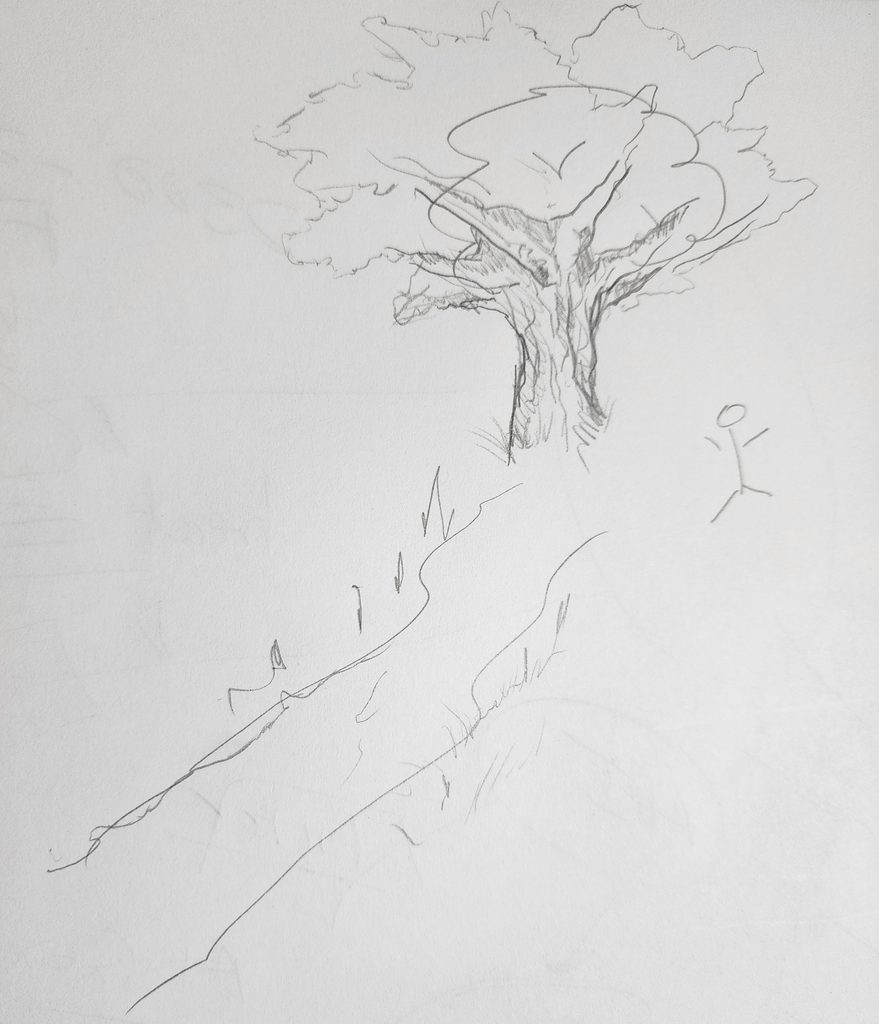
    Pharoah and I made this yesterday, just for the fun of it. Pharoah is a real artist and I was demonstrating my stick figure skills. I also did the brook and the grass. and the bird. Pharoah added beautiful details to my minimalist tree.

    Yesterday, I had the most marvelous experience of getting together with Pharoah Envision, who was brave enough to show his deep, painfully-lived experience in Scenario 2, Hazing, Bullying and Discrimination. We hung out way too long and talked about way too many things. But it was so much fun, nobody wanted to leave. So we waited until the LPM, the Last Possible Moment. Such is the pleasure of good company.

    Pharoah and I talked a lot about things that had happened around the situation he was in. We agreed on two things: that taking that final step was based on not having an out; and even if someone were stopped, they would still be returning to the same miserable conditions, with again, no way out. We laughed wickedly about Leavenworth. Because that’s what we do; that’s how, as Pharoah said, “we bring light.” But to and for ourselves, because sometimes contemplating the reality is too much to bear in its raw state. Our humor and edges are what keep us steady.

    The Reverie

    On the long drive home, in between high beams, theirs and mine; rain slicked roads, and mercurial white lines, I relived the previous five hours. I was interested in the cast, how they coped with the rehearsing, the reenacting, the portraying of behaviors that led to a bad outcome for someone.

    And I say “bad outcome” because we talked about this, how nobody seems to notice when what some people – individuals, groups – are doing is hurting someone. I think the important part of this sentence is right up front: Nobody seems …

    And here is where it exposes a myriad of ways that could happen and still be described by outsiders as “well, nobody [else] seems to [fill in the blank]. Seems to “see it that way.” Seems to “think that.” Seems to “feel that.” Then there is the silent treatment: It’s orders, I have no choice. I was/am just doing my job. Taken together as ways of speaking, the goal is to disappear the problem until either it goes away, the preferred result; or, it becomes huge and unmanageable. The pattern is common in movies, popular series, books, written word. So until someone says it. Until someone holds up a mirror and says, Hey, I see you doin’ that, nothing changes. And the key phrase here is “until someone … says.”

    Until someone says…

    A Flash of Love so Bright

    It’s a long drive between the Pizza 9, with its strong support for the military and military causes and my home in tiny little San Miguel. It’s time to ponder in the silence, beneath the stars and among the mountains, beside the White Sands. And as sometimes happens I think for all of us, there happened a “flash of brilliance.” And I SAW it. I also saw what it meant.

    What I saw was that moment when you realize someone loves you. I mean, really loves you. It’s a jolt, that moment when your body knows and your mind is irrelevant. It’s a moment of stundom, when the world as you knew it is not the same as the world now.

    And it’s not “being loved” because when you say “being loved” you don’t see who is doing the loving. You really don’t even know when it’s happening. Someone could say, “it’s about being loved” and it could refer to having been loved before, now, or in the future. It doesn’t really mean a whole lot.

    But no, it’s that moment when you realize in the now, in the moment, that someone close to you loves you. Loves You and is doing it right now. And your whole perspective changes. It’s moving from dark to light in that instant moment of understanding. Moving from a place of shadow and insecurity to one where you know one, solid thing: That wonderful person loves me and I care. And the myriad details and possibilities of that are worth exploring.

    My dear friend Raul Dorn has graciously allowed me to build a song around two lines, slightly emended, from his new release, Tears. The original lines were

    There was a flash of light so bright

    I could not respond.

    I changed it to

    There was a flash of love so bright

    I could not respond.

    Because I know what that is. I know what that feels like. And when I write the song, the central question will be: Will or could or would or should this stop me? Would knowing deeply and truly that I am loved provide the one way out of the cage without doors?

    I don’t have a song this serious, so I am going to use my silly Christmas song that I wrote just because everybody was writing Christmas songs and I didn’t have one. I am probably the least qualified of anybody to write a Christmas song —but — I did it anyway.

    I wanted a song that didn’t hijack or smuggle in any of the old tropes. And being unqualified to write a Christmas song, this little treat is what emerged from my imagination. I want to say some of the images are a little cheesy [big smirk] but it just wouldn’t do to have Rembrandt with this little tune. Would it. I wish you silly fun.

    #4Suicides

    #ThePTSDLab
  • 4 Suicides & Connection: Who will act with me?

    The Play’s Impact

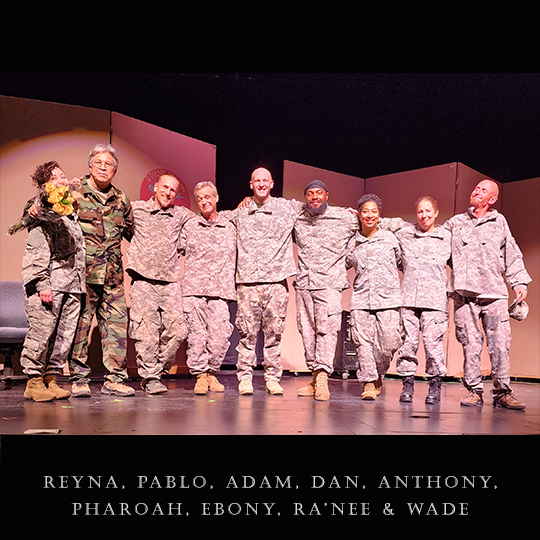
    It’s been several nights since I took this picture, the cast, jubilant, after the performance. The nights have capped days of long and deep reflection, exploring not only the stories the scenarios told but also a question that reaches farther back than immediate response. What is the deepest human need? You might think food, clean water, shelter, safety and security. And these are human needs to be sure, but the deepest, most important need, the one that is essential for survival, is Connection. It is not a question of “who is near me,” who is in proximity, but of “who will act with me.”

    Early humans depended on Connection with others to hunt, gather, prepare and share food and child rearing, organize clothing and shelter. Being denied the resources and protection of Connection would most likely result in death. Over time, as living conditions improved, this type of survival Connection became less and less behaviorally important, but nonetheless remained as a functional artifact in the DNA.

    The Play’s Impact

    As I remembered the play; thought about the play; wrote about the play; I kept thinking: How do we stop this? What I was seeing was the behaviors of the characters toward one particular individual. Seeing it this way was complicated by the fact that I knew some of the cast personally. I knew how wonderful they were as people and I thought and thought about what acting in this particular play might do to them, to how they saw themselves, that ephemeral thing we call Identity.

    But I also realized, underneath all the words I used to describe it, how much it physically and emotionally hurt. Truthfully, I draw away, however reluctantly, from trying to find the words because truly I think there are none. Truly I think this level, like trauma, is beyond human comprehension, too tiny and delicate to perceive.

    But I also wondered: How do we Really Fix This. What I saw was that characters banded together as groups and mobbed their target, taking advantage of vulnerabilities and weaknesses. For days I muddled in Cognitive Dissonance, the state where one input directly contradicts another. My mind would not resolve the two states of wonderful people behaving horribly. Why?

    The Why was not about the play itself, because the play bore highlights of pure genius in that it hit the issues precisely as I knew them from direct experience. And this is very hard to do, because this preciseness is not often encountered in casual conversation. And the recommendations were those that are recommended by the Mental Health Community over all. The play and the production accomplished their missions.

    So it wasn’t about that. The question was more at What could make a group of ordinary people turn savage, turn on one of their own and pursue the activity to its terminus. That was the question: Put simply, Why did they do that?

    Prehistory

    So I thought: What would cause the most Fear? My current conclusion is that it’s Abandonment. Because in prehistory, Abandonment meant certain death, from cold, from starvation, from becoming prey. And that Fear, Fear of the loss of Connection, is so old, it is deep-seated and doesn’t usually show up cognitively. Instead, it shows up physically.

    If we look at scenario 1 through this lens, loss of Connection, we see Willem isolated in a corner playing video games. Willem was once part of the group of five, but losing his girlfriend has been terrible for him and he has retreated into himself and his games as solace for his wounds.

    If we look at it from the group’s perspective, we see that they see they have lost a friend, a colleague, a teammate: they have lost a close Connection. They can see him; he is there but he is not “with” them. He is some place far away in his own mind and grief although he is physically present.

    There is no logic that arises to say that the loss of a member is important. Instead there is only the Fear, that deep, historic, visceral, understanding that Connection is absolutely necessary for survival. And so they express that Fear, becoming more and more savage in their assault as the Fear deepens with every movement Willem makes away from them.

    But there is a whole other side to this scenario. One that relies on those deep-seated understandings, but uses them to create protection for them, enabling them to present the play while keeping those experiences that make them who they are intact.

    Protection: The Magic of Love

    From when I first entered the rehearsal space that Saturday, I felt openness, space, ease among the people. It felt nice. Over time and interactions with people, it continued to feel nice. I didn’t put any words or stories to this at the time, just followed along on the feeling of niceness. It was comfortable; Pablo made me feel really at home and didn’t make me feel like I had a spotlight on me.

    So it was against this background that a pattern emerged. But the words seemed to fit naturally with what I was feeling and so it took me a while to get it, and then another while to figure out how to talk about it.

    The pattern was that everyone was talking about how wonderful the team was. Not the “teamwork” as one might expect, but the team members themselves. The people who made the production happen with love and dedication. That’s what was the subtle music for the group. They loved and respected each other deeply. And it showed, it showed in how they talked about each other, how they moved together. And I kept hearing it over and over and I just didn’t see it, because it fit the experience I was literally basking in so comfortably. It was too much of an overlay for me to see the distinction.

    And then someone said it directly to me; it wasn’t just the casual hearing, the way things come up in friendly, casual conversation. And I thought, If this person whose opinion and ideas I value so highly is insisting about this, there has to be something I’m missing.

    So I turned it around, and instead of using my understanding of teams and the ease in the space of happy teams, I looked instead at what people were actually saying. This was something different from your average really good team. People talked about the team. That is: They Talked. About it.

    I suddenly saw it as a circle, protection within the circle’s space. The cast and everyone were working with some extremely powerful material. There was danger in the exposure that maybe no one said and no one talked about or maybe they did. Because they intuitively built this really close group, a group where the Connection and the proximity protected them from the often-devasting material they were enacting. And they intuitively kept reinforcing the Connections, drawing on their power for survival, not just physically but psychologically, emotionally. At the rehearsal that Saturday, Ebony’s response to Ramirez’ loss was so deeply felt by her and by me that I was crying with her. How many times were there moments like this for people over the days and weeks of rehearsals, of meetings, of decisions and actions.

    Would I know all this this way if I hadn’t been there? If the Universe hadn’t conspired in some fashion to put all the right options in front of me? No, I wouldn’t. Because observations on this level of nuance and understanding can’t be represented in words because they don’t have sound or feeling.

    But What If They Didn’t Do That?

    But, and this is the point of this Reflection, really: Suicide Prevention is doing what it can with the current model, and everyone agrees there is room for improvement, new ways of looking at things that can perhaps go beyond assisting individuals in immediate crisis. What if we look at stopping the behaviors that stress and challenge people who are struggling, people who are vulnerable? In 4 Suicides, all four scenarios used some form of abusive behavior to push the person beyond their ability to cope at that moment.

    But what if they didn’t do that? What if they understood that their behavior was saying they were afraid because they had lost their friend, their teammate, their comrade? What if what they were really saying was, We have lost you. Come back, please. We need you. What if they knew what they were really saying with the attacks? Would they change to protect their loved ones from the final escape?

    People really do need to know things like this. That some of the things we do are ancient, historic, literally baked-in to our DNA. They need to know they can change their behavior and prevent bad things like losing loved ones from happening.

    Is It Worth Changing?

    I have a song for people who may think that understanding behavior is not useful as a Suicide Prevention method. I wrote it for my baby Zeke; he was 12; he was feral and he added so much to my life. It’s called The Very Last Time. Think on it maybe because “gone” in this world is “forever.”

  • The Challenge – the Play – the Community

    No one can fault the quality of Theater here in Cruces but the Arts community in Alamogordo and the Tularosa Basin is equally impressive – but in a quite different way and maybe that difference is worth exploring –

    Unlike Cruces, which tends toward Broadway and the Classics, in Alamo, productions explore local concerns. And like 4 Suicides…, the people who are this amazing production are locals deeply devoted not just to the performance, but to the complexity and challenge of Suicide as the final countdown.    

    On Friday evening, the Flickinger on Main Street in Alamogordo will present 4 Suicides Looking for a Place to Happen. It is written and directed by Pablo Jasso, an Air Force and Army veteran who has been in theater for over 40 years.  Jasso came face to face with the statistically relevant causes of military suicide while working at Fort Bliss as the museum history specialist. His own experience and conversations with others on the post inspired him to put these stories to the public in a form he knows best: a play.

    The play, beginning with the form, concept and cadence of the title, is strongly reminiscent of Pirandello’s 6 Characters in Search of an Author. I mentioned this to Pablo in my first e-mail, the strong correspondence not only in the title but also in the deeper explorations of Identity, Reality and Illusion that surely was not accidental. And indeed it went beyond a simple, apparent accident, a sound pattern remembered from earlier, but the secret framework, the inspiration, for 4 Suicides… In Cruces, you are likely to see a play by Pirandello; in Alamogordo, you are likely to see a play that exposes the everyday realities as seen through the lens of a Pirandello play.

    The plays’ similarities to each other, touching only lightly in action but deeply in philosophy, but both expose the deeper often hidden realities of individuals in crisis. In 6 Characters…, the characters exist but are searching for an Author: the embodiment of that force that will show them as who they are with their Identities, relationships, events and competing meanings intact, and do this without replacing them with someone else’s interpretations. They want their realities to come to life as they are, in the words, rather than being someone else’s illusory story. In 6 Characters… and in 4 Suicides…, this unflagging, deep and revealing honesty is important.

    4 Suicides Looking for a Place to Happen… doesn’t tell you “about” suicide; it shows you precisely how it happens; shows you what leads up to it. And you see the truth in the faces of these actors and actresses. And you see it in context, with all the supporting details.

    And what’s “honesty” in this context? And then, Why? As a multiple attempt survivor, I can answer why: it is because there was no other way out of feeling of being locked in a really bad place — with no way out. And we see over and over in each of the four acts of this absolutely brilliant play.

    I say brilliant but it’s not brilliant in the way of Shakespeare or Andrew Lloyd Webber. It’s brilliant in that it’s spot on. Shakespeare and Andrew Lloyd Webber show you stories; Jasso engages you in the reality. The play, the people on the stage, show you what’s often hidden, and the paths that lead to finally finding a way out ——

    How to Go

    Join us at the Flickinger, 1110 New York Avenue, Alamogordo, New Mexico for the 6pm performance. Doors open at 5:40 pm. Admission is free but donations of canned or dry food; unopened hygiene products; and gift cards. These will help in being there for homeless and at-risk veterans.

    About the Image

    The image is mine, born in service of a song, crafted with one of my AIs and perfected with Photoshop. Used here because it fits.

  • Site Colors: Three, Just Three

    They match the categories. In the context of this black and white site, the colors function like street signals, except we have white, not red, and they signify complex information. In the plain black and white field of Exploration, there’s no distracting competition, no contrasting meaning.

    Putting these in context, we have three Tags for the whole site: Scary, Good, and Scary good. I put them in that order because I like the “Scary” bookends.

    So for each one, I chose some nice colors. Scary is White. It’s White because the whole field, unblemished, is open. Like unbroken snow. [Unbroken Snow, album by Creosote.]

    Good is Yellow. Sunny. Happy. Totally safe, no worries here. Like a fabulous day in a forest, brook babbling beside you, trout hiding in the hidey holes carved by the eddies in the ebbs and flows of the streams and the seasons. All is well here.

    Turquoise is Scary Good. Well, because I live in the US Southwest and Turquoise is scary good here. Lots of beautiful jewelry is made by the Indigenous Peoples here. Turquoise is the color of Adventure; of making it over the next rise as the day blooms.

  • Hello

    Hello

    Hello!

    It’s just as well that I talk about what we are doing here. So far as we can tell, no one has ever done anything quite like this before.

    What is “This?”

    This is an exploration through the general cases of disinformation. You will say, Isn’t that “misinformation?” No. Disinformation as I use it is when people use often subtle tools to force people to see the world their way.

    By a happy convergence of Events in the sidewinding of time, I discovered a language that thought the way I did. And there was none of that stuff they talk about in English: the exploration, the falling in love, the romance. No. It just Was.

    Was: A recognition so deep and so old there was no space in Time between one and the other. It was a recognition that came from the body’s embedded knowledge, the knowing that this was what it was and it could never be anything different.

    It’s a Knowing that’s as Ancient as the language that reflects it. It’s a Knowing that needs no questions. And it’s the kind of Knowing that has merged so deeply that the word is only a superficial referent.

    We talk like that a lot.

    The site is called The PTSD Lab because I want to show people how they can live better by understanding how unseen tools have shaped their worlds. Like so many things, people who have imagined themselves to be “superior” have defined for themselves and consequently for us, who and how we are.

    This is called epistemic override: It’s the power of language to make you doubt your own reality. This is not a misunderstanding.

    The dismissal of us, the conversion from human to object happens at the moment someone says “Oh, I know what that is.” Because that sentence closes the field in that it denies any other possibilities and so converts our lived systems into their categories.

    When Semantics says, closes the field, its really is saying, There’s no other way to go from here. I’m saying, Yes, there is.

    The Collection here reflects my own interests in service to the goal. That intense need to say, People, it’s their language. Defeat the language by not accepting the finality and explore more deeply. More Freely.  My book was about Freedom and it means it.